
The Six Basic Stitches Behind Most Embroidery
A stitch sampler in the colors of Cézanne’s Still Life with a Ginger Jar and Eggplants
Colors in master paintings have a quiet way of speaking to needlework. For this embroidery sampler, I took my cues from Paul Cézanne’s Still Life with a Ginger Jar and Eggplants and pulled a palette of comforting blues and greens, a warm terracotta, a rich plum, and a juicy garnet, then matched each one to DMC embroidery floss. I typed the labels on my granny’s old Underwood typewriter and stitched six basic stitches that most hand embroidery is built on. Here’s how it came together.
The blues and greens, terracotta, plum, and merlot I pulled from Paul Cézanne’s Still Life with a Ginger Jar and Eggplants (1893-94, The Metropolitan Museum of Art), with the DMC floss I matched to each.
The Palette
Everything started with the palette. My instinct is always to go blue, and this painting has plenty of it. This time I resisted the pull and leaned toward green, which I always find hard to work into a palette. My color taste has been moving deeper lately, toward jewel tones and away from anything bright and keyed up, so the plum and garnet felt right at home next to the muted greens and slate blues.
The garnet has another thread running through it. It was my great-grandmother’s birthstone, and she never went out without at least one piece of garnet jewelry.
Here are the six threads, with the names DMC gives them:
436: Metallic Teddy
924: Tahitian Pearl
433: Chocolate
29: Emperor Purple
3750: Dark Petrol Blue
814: Vin Rouge
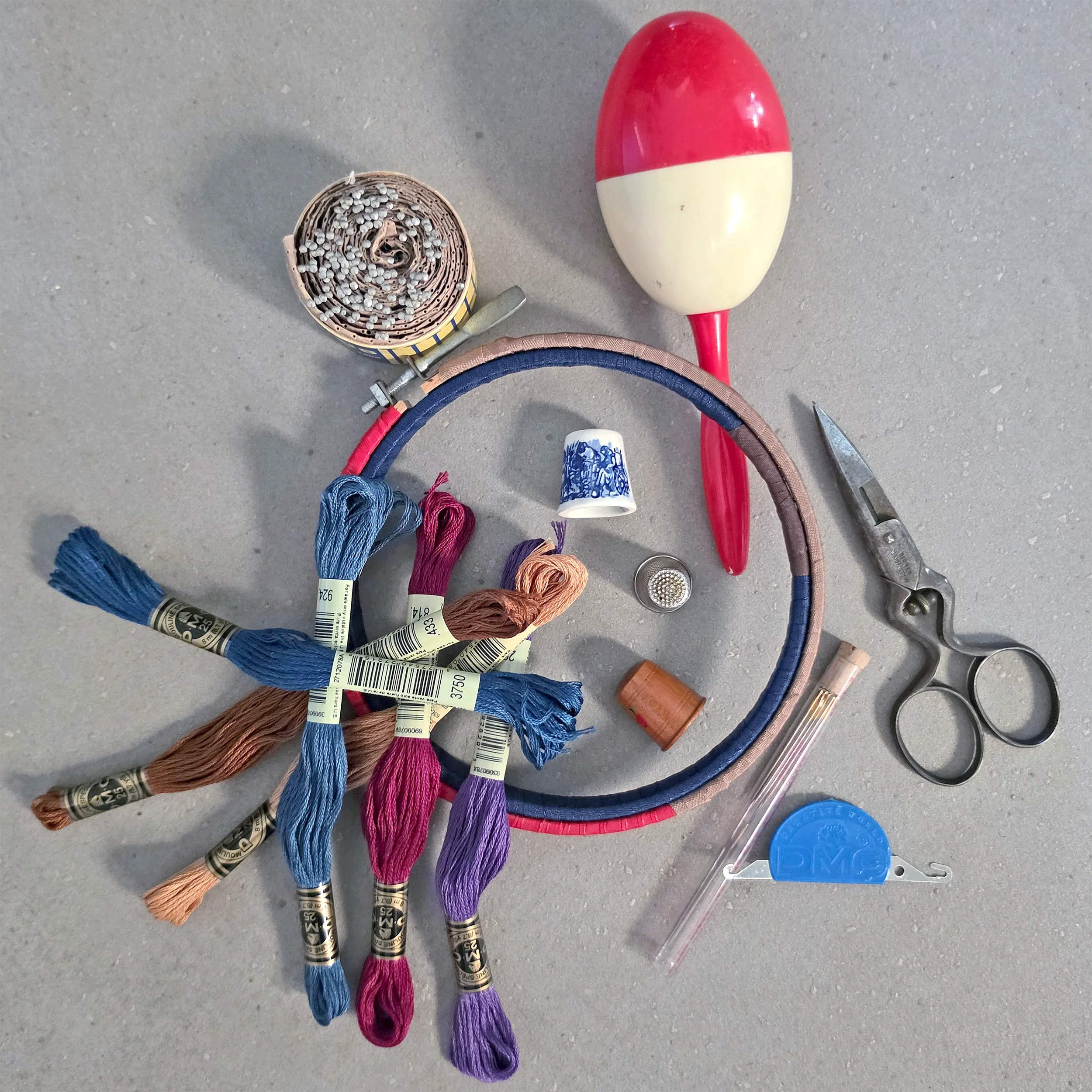
My stitching kit
Six skeins of DMC floss and a seam-binding wrapped hoop, plus my great-grandmother’s scissors, darning egg, and thimbles.
The Tools
The hoop is bamboo, wrapped in scraps of rayon seam binding from my grandmother. She finished every seam of her handmade clothes with it and never threw away a bit. I wrap all my hoops this way now, because it adds padding and there’s no chance of splinters. (More on wrapping a hoop coming soon)

My granny’s Underwood
Her old typewriter, loaded with fabric instead of paper.
The Labels
I typed each stitch name onto a strip of fabric loaded into the typewriter, then ironed the labels onto the sampler. (More on making iron-on fabric labels with a typewriter coming soon.)
The finished sampler, with each stitch beside its typewritten label.
The Sampler
And finally, I got to the best part, the stitching! I stitched the sampler on unlaundered muslin. I like its natural color, and skipping the wash keeps the factory finish, which gives the fabric good body for stitching and handling.
The six stitches are running stitch, back stitch, chain stitch, blanket stitch, French knot, and lazy daisy. This is the sampler we make in my Introduction to Handstitching Workshop.
Try It Yourself
Pick a painting you love, or one whose colors are intriguing, and pull a handful of colors from it, stitch each stitch in a different one. A sampler is a good place to see how colors sit next to each other before you commit them to a bigger piece.
If you have questions, leave a comment below. And if you stitch something from a favorite painting, I’d love to see it.
The threads and tools I use are on my Favorite Things page.