
Paisley No. 1, stitched in DMC Pearl Cotton #5 in pink (DMC 961), blue (DMC 825) and teal (DMC 959) onto muslin
About the Design
Paisley is an ornamental textile design built on a teardrop-shaped motif with a curved tip, called boteh in Persian, or buta. Boteh means bush or shrub in Persian, and buta means flower in Hindi-Urdu. The design is Persian in origin and became popular in the West in the 18th and 19th centuries, after Kashmir shawls carrying it were imported from India and then copied. The English name comes from the Scottish town of Paisley. Scholars disagree about how old the motif is and what it first meant. One common view is that it began as a floral spray combined with a cypress tree, a Zoroastrian symbol of life and eternity.
I’m not a historian of textiles, so this is only a short summary, and I’ve linked a few sources below for anyone who wants more. I drew this one for a quilt inspired by Indian textiles, adding non-traditional elements and stitches.
If you’re interested in learning more, here are some sources I found helpful:
A history of handwoven shawls in India’s Kashmir region, which cites University of Oxford research and Michele Maskiell’s article “Consuming Kashmir,” Journal of World History (2002)
How I Stitched It
This pattern uses seven stitches, all in DMC Pearl Cotton #5. Pink (961) works the border and the wheels at the tail, blue (825) the rings and the daisy, and teal (959) the running stitch and the little wheel near the head. The labeled photo below shows which is which. Slightly uneven stitches give the line its life, so don’t worry about matching every one. It’s a good sampler for anyone who wants to try several stitches on one small piece. These are not traditional stitch choices, but ones I chose for their variety and textures.
The Stitches
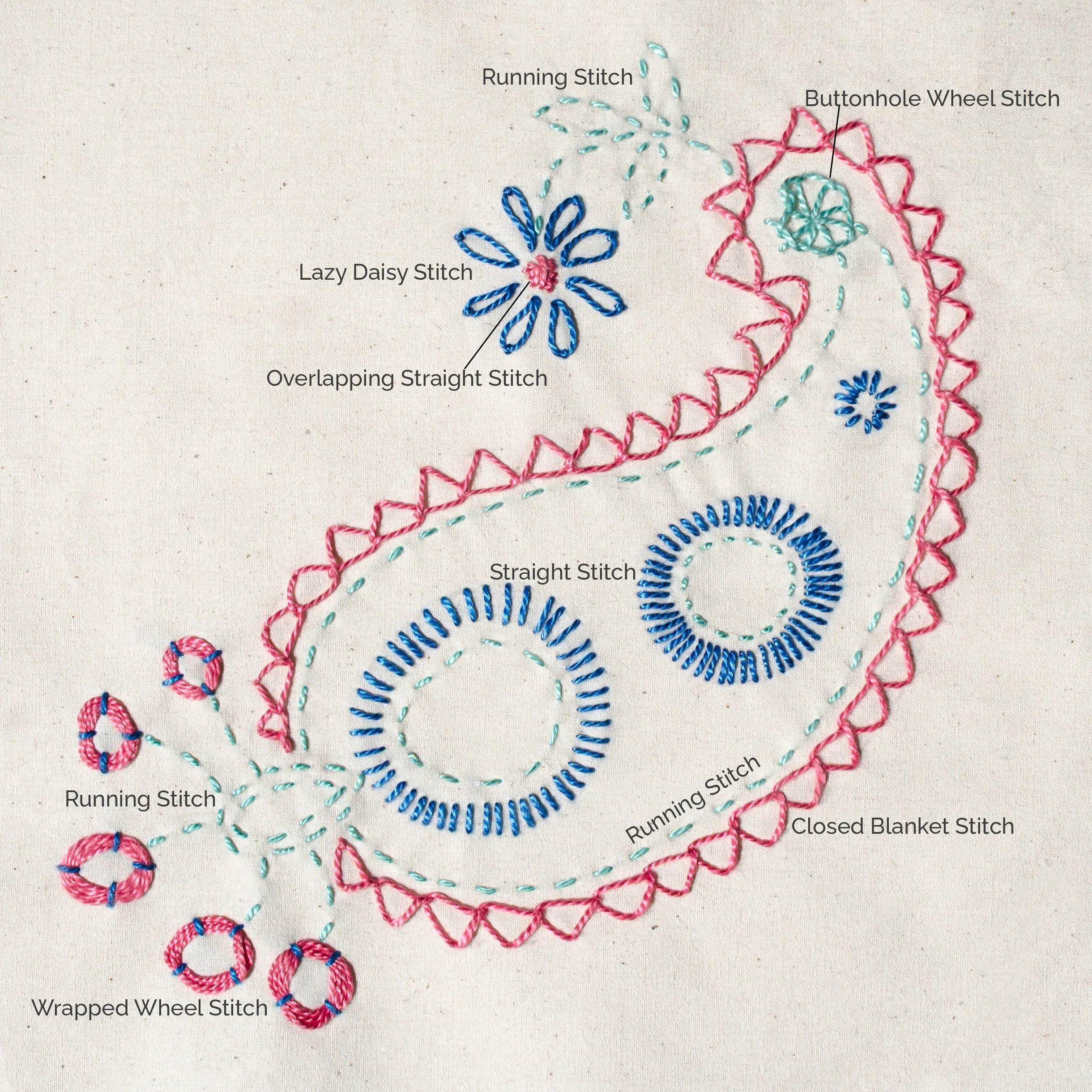
Stitches used: closed blanket stitch (also called closed buttonhole stitch), running stitch, straight stitch, lazy daisy, overlapping straight stitch, buttonhole wheel stitch, and wrapped wheel stitch. There’s a step-by-step diagram of the wrapped wheel in Sikku Kolam No. 1.
Mending and Materials
A closed blanket stitch border is a pretty way to finish the edge of a patch, and it gives a repair a clear outline. The rings and wheels are useful for covering a small stain or a worn spot.
You don’t need to buy anything to begin. A scrap of cotton, a worn napkin, or the back of a shirt that needs attention will do, along with any thread you already own. The pattern is open to your own colors and stitches.
Download the free pattern PDF below, print it at 100% scale, and transfer it to your fabric. A window and a water-soluble marker work well. If you stitch one, I’d love to see it, so leave a comment and tell me what fabric and thread you chose.
Looking for more? Browse all the free embroidery patterns.