
Sikku kolam No. 2, stitched with running stitch and wrapped wheel stitch in white DMC Pearl Cotton #5 onto pink Shot Cotton by Kaffe Fassett
About the Design
This is the second in a series of free sikku kolam embroidery patterns. Sikku Kolam No. 1 is also available to download.
Sikku kolam (also called kambi kolam) is a South Indian tradition of drawing a continuous looping line around a pattern of dots, traditionally in rice flour at the doorstep. The dots are called pulli, and they are the fixed points: the line is drawn around them and never touches them.
Where No. 1 sits on a square grid of sixteen dots, this one has ten dots in a diamond. The line crosses itself in a lattice through the middle, sweeps out in two long curves on either side, and loops around the dots at the top and bottom. The top mirrors the bottom, and the left mirrors the right.
I’m not a practitioner of this tradition. I chose the pattern for its beauty and adapted it as a stitch pattern. If you’d like to read more about kolam, I wrote about it in Sikku Kolam No. 1.
How I Stitched It
The stitching is the same as No. 1, worked in a single color this time. White running stitch follows the line, and a white wrapped wheel fills each of the ten dots, so the whole design reads as one pale drawing on cotton. The line doesn’t need to be perfect. Small differences in stitch length are part of the look. It works for a first embroidery project and for an evening when you just want a needle and a quiet hour.
Stitching the Dots
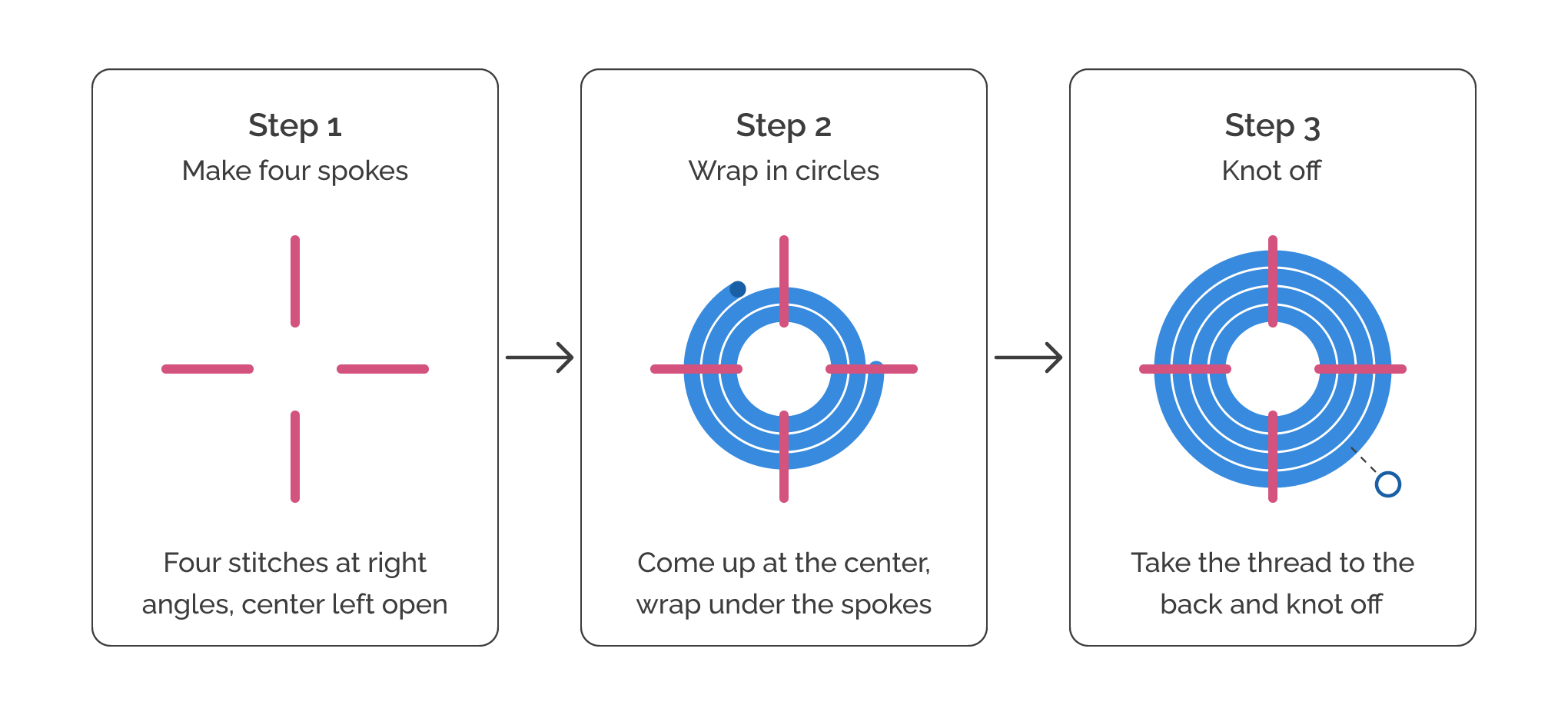
The dots are wrapped wheel stitches, the same as in No. 1: four spokes, then thread wound around them in circles. I wrapped these in white and left the center open. There’s a longer walkthrough in Sikku Kolam No. 1 if you’d like more detail. The diagram below shows the colors from No. 1; my stitches here are all white.
Mending and Materials
The long curves in this pattern are good practice for keeping a running stitch even around a bend, which is the same skill you need to follow the edge of a patch or a repair.
You don’t need to buy anything to begin. A scrap of cotton, a worn napkin, or the back of a shirt that needs attention will do, along with any thread you already own. White is only what I used. The pattern is open to your own colors and stitches.
Download the free pattern PDF below, print it at 100% scale, and transfer it to your fabric. A window and a water-soluble marker work well. If you stitch one, I’d love to see it, so leave a comment and tell me what fabric and thread you chose.